Article • 11 min read
AI customer experience: Boosting personalization and efficiency
Use artificial intelligence to enhance the customer experience at every stage of the buyer’s journey.


Candace Marshall
Vice President, Product Marketing, AI and Automation
Última atualização em April 2, 2026


What is AI customer experience?
AI customer experience (AI CX) is the application of artificial intelligence to optimize, personalize, and streamline customer interactions across channels. It uses technologies like agentic AI and machine learning to understand intent and adapt in real time. Modern AI CX goes beyond simple automation by taking action and proactively resolving customer needs from pre to post-purchase.
Think about the last time you needed help from a company. You expected a fast answer, a clear resolution, and a conversation that felt easy and friendly.
That expectation isn’t unique. As AI becomes more embedded in everyday experiences, customers have grown accustomed to consistent service across every interaction. According to the Zendesk CX Trends Report, 67 percent of consumers say they expect more personalized service now that AI can analyze their past interactions.
For businesses, this shift has moved AI from an experiment to an essential part of customer experience. The challenge now isn’t whether to use AI—it’s how to use it effectively. In this guide, we’ll explore how AI is transforming CX, the benefits it brings, and practical ways to deliver faster, more efficient, and highly personalized customer experiences.
More in this guide:
- Benefits of AI in customer experience (CX)
- 13 ways AI can improve the customer experience
- Key challenges in AI-driven customer experience
- Top trends in AI for customer experience
- Examples of AI for customer experience
- Frequently asked questions
- Transform your CX with Zendesk AI
Benefits of AI in customer experience (CX)
AI is changing what great customer experience looks like. It helps businesses deliver faster service, personalize every interaction, and operate more efficiently at scale. The result is stronger customer relationships, better retention, and more consistent growth.
Personalization that builds loyalty and drives growth
AI enables businesses to move beyond one-size-fits-all support. By analyzing behavior, context, and past interactions, it can anticipate what customers need and tailor each interaction in real time. This makes every experience feel more relevant, which increases trust, improves conversion rates, and strengthens long-term loyalty.
Faster, always-on support that improves efficiency
AI allows teams to deliver immediate support without sacrificing quality. It can handle common requests, guide customers through next steps, and escalate complex issues when needed. This kind of customer experience automation helps reduce wait times, lower operational strain, and free teams to focus on high-impact work.
AI also improves how requests are routed and prioritized through intelligent triage and smart assist, ensuring customers reach the right support faster and agents have the context they need to resolve issues efficiently.
Connected experiences across every touchpoint
Customers expect continuity, no matter which channel they reach out through. AI helps unify data across channels so conversations feel connected instead of fragmented. Customers don’t have to repeat themselves and teams can respond with full context, leading to smoother and more consistent experiences.
Real-time insights from customer signals
AI analyzes conversations, feedback, and behavior at scale to uncover patterns that would otherwise go unnoticed. With tools like AI customer feedback, teams can better understand sentiment, identify friction points, and act on issues sooner. This makes it easier to improve service quality continuously and respond to changing customer needs.
Stronger revenue and relationships through smarter decisions
AI helps teams prioritize what matters most. It can surface high-value opportunities, recommend next best actions, and support more informed decision-making. This leads to better customer engagement, more efficient workflows, and stronger business outcomes over time.
13 ways AI can improve the customer experience
While the benefits of AI in CX are clear, from stronger loyalty to greater efficiency, those outcomes depend on how AI is applied in practice. Here are 13 ways AI improves customer satisfaction and helps teams work smarter every day.
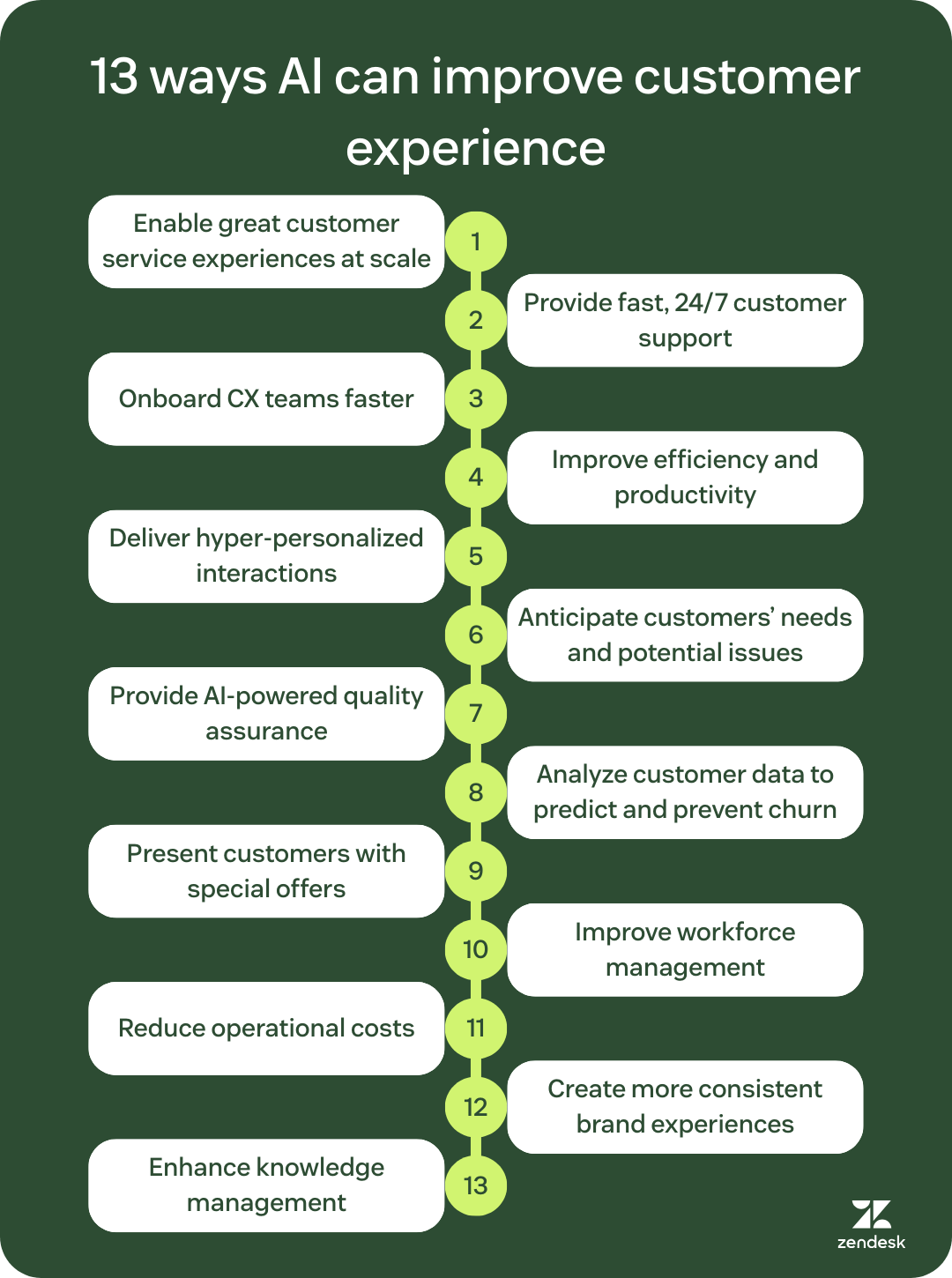
1. Enable great customer service experiences at scale
AI helps businesses manage higher support volumes at scale. It also helps maintain customer satisfaction and build customer loyalty.
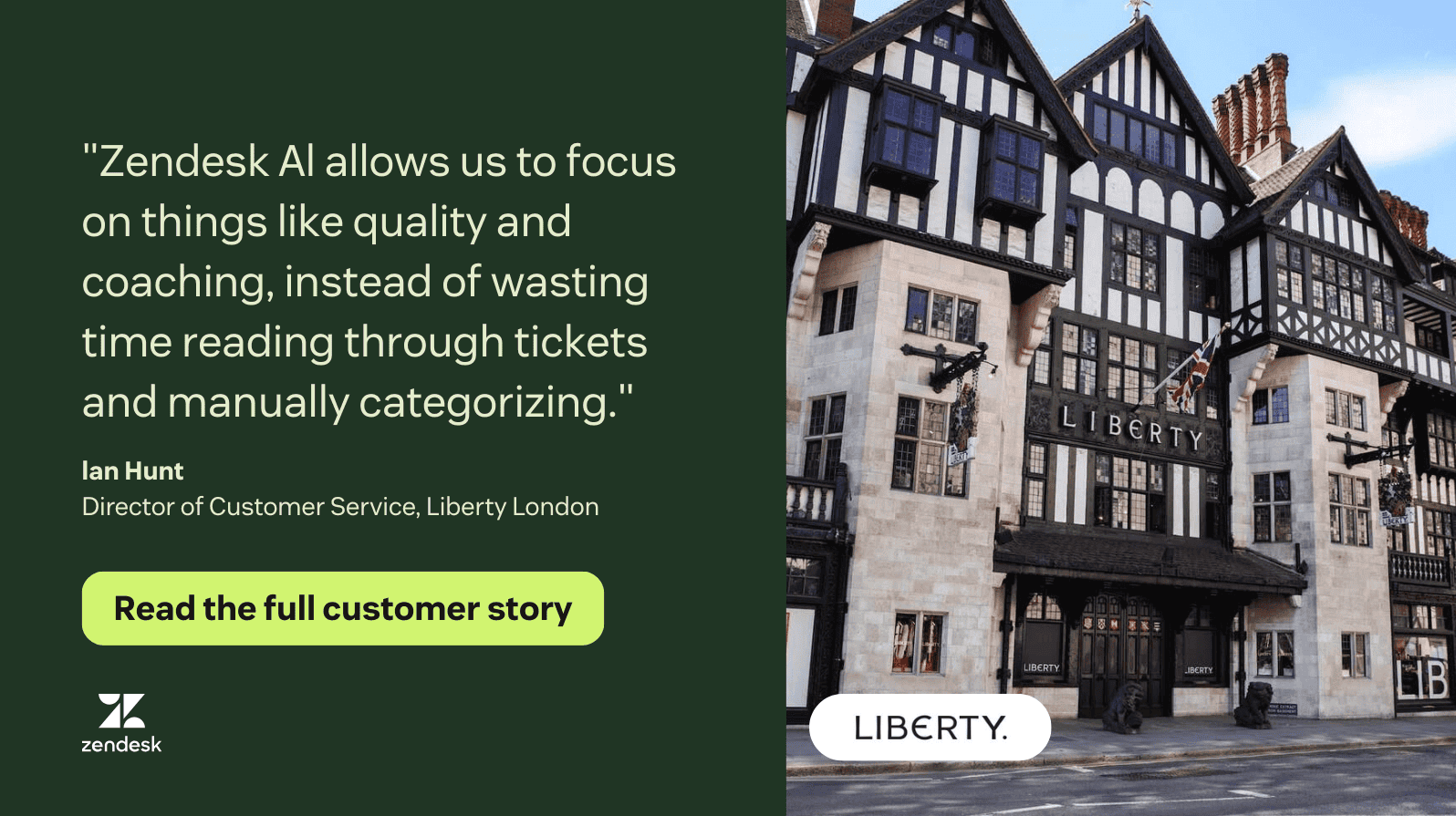
For example, AI can arm agents with insights to personalize every customer interaction. Liberty London, an iconic UK premium department store, uses Zendesk AI to identify and label:
Customer intent (what an issue is about)
Sentiment (whether it’s positive or negative)
Language
This gives agents a clearer understanding of each customer’s needs.
Additionally, businesses can deploy AI across email, social media, live chat, messaging apps, and more, to scale their support across channels. These tools help teams manage growing demand and resolve customer requests more efficiently. This is especially valuable during peak periods, such as the holiday season or a product launch.
2. Provide fast, 24/7 customer support
Customers expect 24/7 support that’s fast and convenient. As expectations rise, instant and accurate responses are no longer a differentiator—they’re the baseline.
AI makes this possible by delivering support around the clock. AI agents can understand customer intent, respond in natural language, and guide customers through next steps at any time, including nights and weekends. They can handle common requests independently and escalate more complex issues to human agents when needed.
This evolution goes beyond traditional chatbots. Modern systems use conversational AI to deliver more dynamic, context-aware interactions that feel seamless and relevant.
AI also helps human agents respond faster and more effectively. Intelligent tools can suggest replies based on conversation context, reducing the time spent writing responses. Generative AI can expand a few words into a complete, ready-to-send message. These capabilities help teams improve response times, reduce handle times, and deliver faster resolutions.
3. Onboard CX teams faster
When it comes to getting new customer service agents up to speed, AI can play a key role. AI acts as a real-time assistant, giving new hires tips and feedback as they navigate customer service training and live interactions. For example, AI can shift the tone of their replies to be more friendly or formal. It’s also able to surface similar support tickets so agents can see how teammates responded to the same question, helping them learn faster and reply with more confidence.
4. Improve efficiency and productivity
AI helps teams work more efficiently by simplifying workflows and reducing manual tasks. It can handle routine requests and automate repetitive processes, allowing agents to focus on complex issues and high-value work. In many cases, chatbots can help agents improve customer support by taking on common questions and supporting faster resolutions.
AI also improves how work is distributed across teams. It can analyze incoming conversations to understand intent, sentiment, and urgency. This helps route requests to the right agent faster and reduces unnecessary escalations. As a result, teams are able to respond more quickly and handle higher volumes without increasing workload.
5. Deliver hyper-personalized interactions
AI can act like a personalized concierge for every customer. It understands their history and preferences, helping agents better understand their needs.
For example, the sustainable e-commerce brand Grove Collaborative uses AI-powered insights to support more personalized service. Instead of replacing human interaction, AI provides agents with the context they need to respond more efficiently and deliver tailored experiences.
6. Anticipate customers’ needs and potential issues
AI uses data like order history, behavior, and preferences to anticipate customer needs. It can also identify potential problems before they escalate. This allows teams to take proactive action and improve customer retention.
For example, fashion retailer Motel Rocks uses AI to streamline customer service with intelligent triage and sentiment analysis. Incoming messages are automatically classified based on intent and emotional tone, helping agents quickly understand the situation and prioritize responses.
AI is also able to assign a simple emoji to reflect the overall sentiment, from negative to very positive. This gives agents a quick visual cue and helps them prepare for each interaction.

7. Provide AI-powered quality assurance
Traditional quality assurance in CX often relies on manual reviews. AI-powered quality assurance makes this process faster and more consistent by analyzing customer interactions at scale.
AI can score agent performance, detect customer sentiment, and highlight areas where coaching is needed in real time. This helps teams identify trends, address issues earlier, and improve service quality continuously. It also allows businesses to deliver more consistent experiences and tailor training to each agent’s needs.
8. Analyze customer data to predict and prevent
AI-powered tools help support teams identify customers at risk of churn by analyzing sentiment and behavior across interactions. This makes it easier to spot issues early and take action before they escalate.
AI can process large volumes of conversations and surface patterns that signal frustration or dissatisfaction. It also provides alerts and recommendations, helping teams prioritize at-risk customers and respond more effectively.
Sentiment analysis also helps teams better understand how customers feel about their experience. This makes it easier to identify gaps, improve service, and reduce churn over time.
9. Present customers with special offers
AI helps businesses present relevant and timely offers based on customer behavior and preferences. By analyzing purchase history, browsing activity, and other signals, it’s able to identify products or services customers are more likely to engage with.
For example, AI can recommend items similar to previous purchases or highlight products a customer has already viewed. It can also trigger promotions in real time. An abandoned cart, for instance, prompts a personalized offer that encourages the customer to complete their purchase.
10. Improve workforce management
AI is increasingly used to improve workforce management in customer service. It helps teams automate routine tasks, surface insights, and plan staffing needs more effectively.
It can analyze historical data and customer behavior to predict demand and recommend how many agents are needed at any given time. It also automates scheduling and provides real-time visibility into agent activity. This helps teams stay efficient, reduce manual work, and maintain consistent service levels as demand changes.
11. Reduce operational costs
AI helps reduce operational costs by automating routine tasks and handling common requests through self-service. This lowers the volume of inbound support and reduces the need for manual effort.
It can also surface recommendations and insights that help teams work more efficiently. By anticipating customer needs and streamlining workflows, it allows teams to manage higher demand without increasing resources. This is especially valuable during periods of growth or economic change.
12. Create more consistent brand experiences
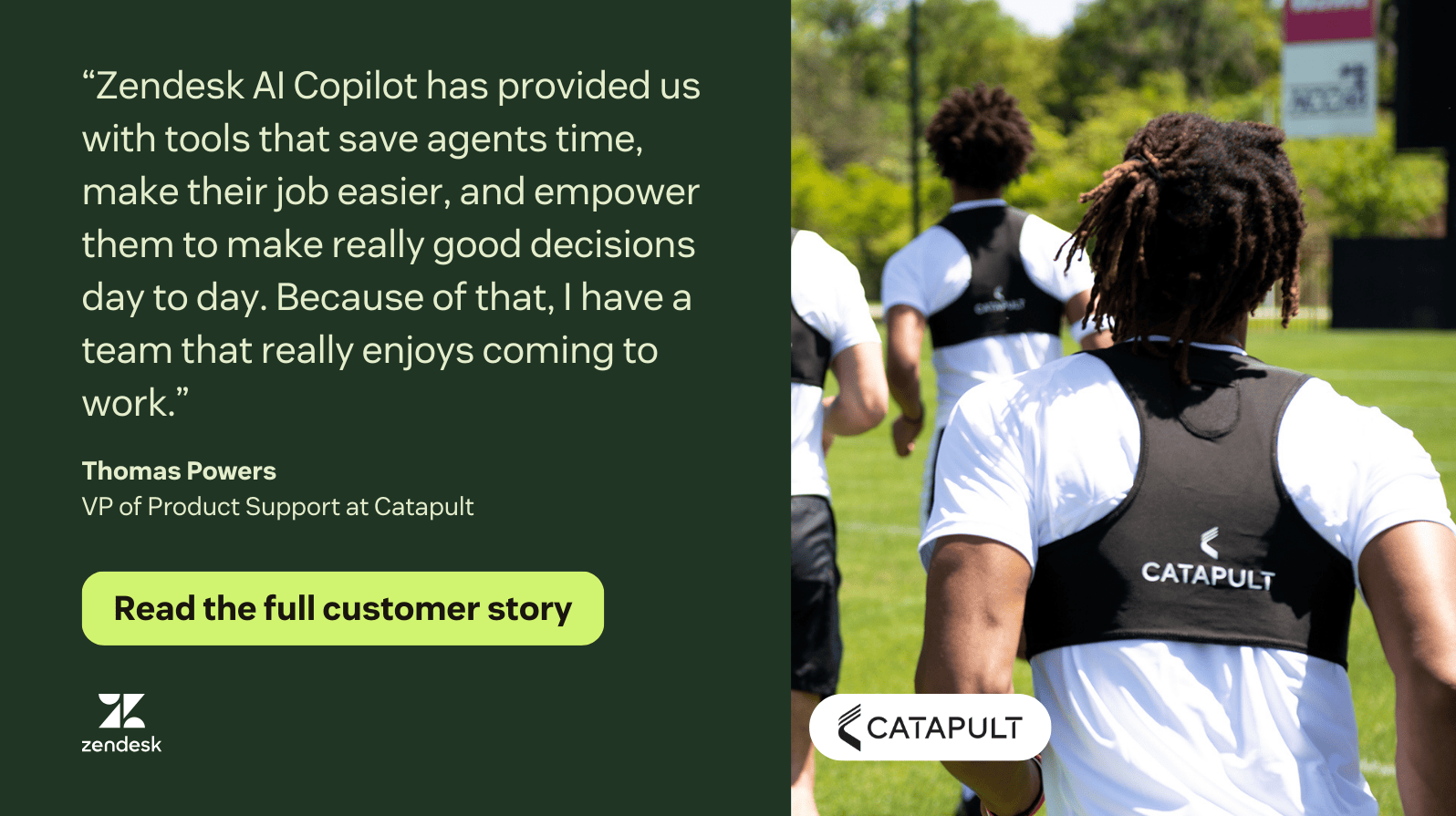
Generative AI helps businesses maintain a consistent tone and voice across customer interactions. It can adapt responses to match brand style, ensuring every conversation feels aligned. This consistency helps strengthen brand identity and improve customer trust.
Agents also adjust their tone in real time during conversations. Tools like tone-shifting features allow messages to sound more friendly or more formal, depending on the situation. This helps teams communicate more effectively while staying consistent with brand guidelines.
13. Enhance knowledge management
Self-service is a key part of delivering strong digital customer service.
AI-powered knowledge management tools keep help center content accurate and up to date. They identify low-performing articles and suggest improvements, making it easier for teams to maintain useful and relevant resources. This helps customers find answers on their own and reduces incoming support requests.
Content creation also becomes faster and more efficient. Generative AI can turn a few bullet points into a complete help center article in seconds. It’a also able to adjust tone to match brand guidelines, helping teams create consistent, high-quality content with less effort.
Key challenges in AI-driven customer experience
AI has quickly become essential for delivering modern customer experiences. But implementing it effectively comes with real challenges. To succeed, businesses need to balance speed, personalization, and efficiency with trust, consistency, and control.
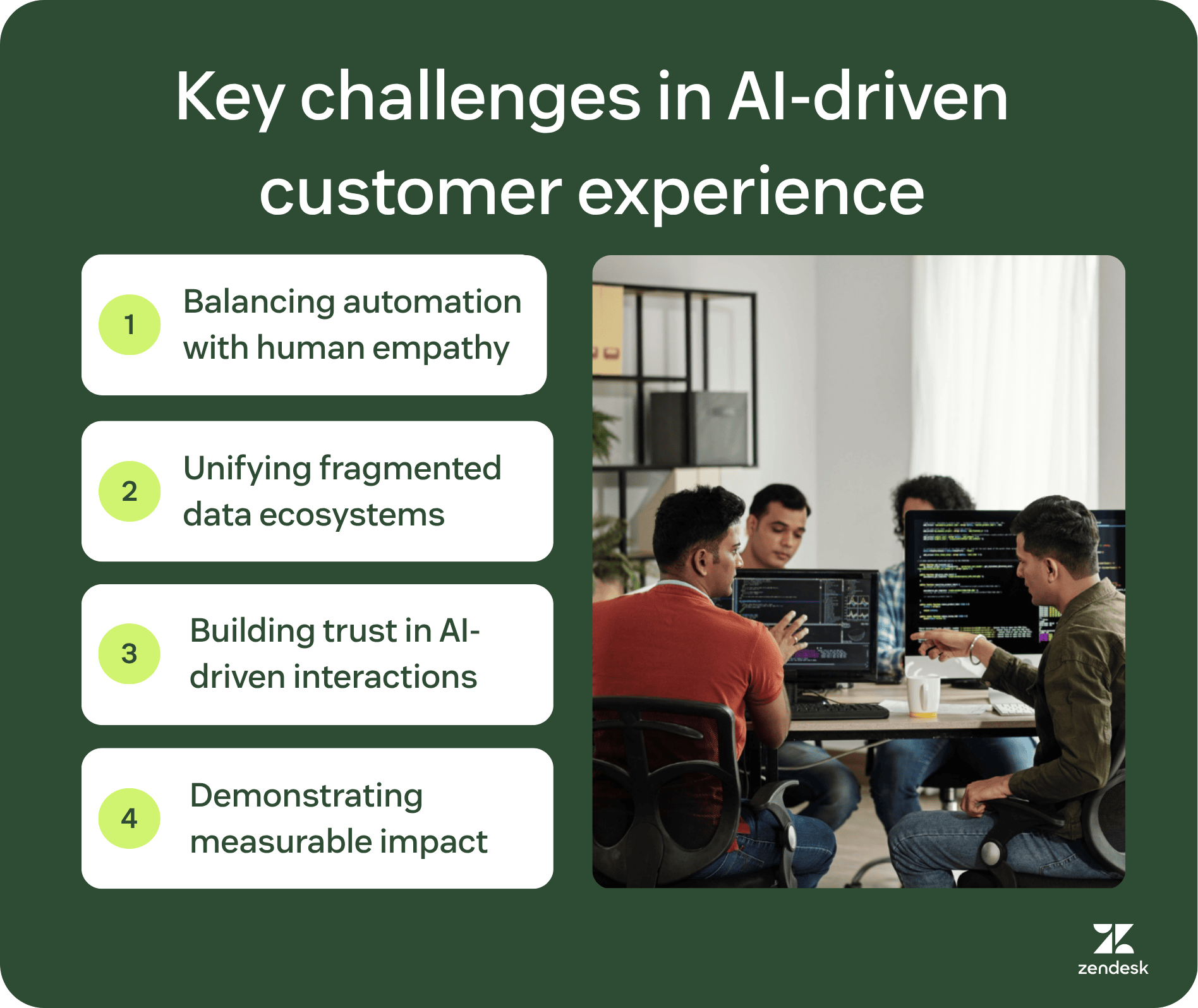
Balancing automation with human empathy
AI improves efficiency, but too much automation risks creating a disconnect. Customers still want to feel understood, especially when issues are complex or emotional. If interactions feel robotic or impersonal, trust can erode quickly.
The challenge is finding the right balance. AI should support agents and handle routine tasks, while humans step in when empathy and judgment matter most. This ensures customers get both speed and meaningful support.
Unifying fragmented data ecosystems
AI is only as effective as the data behind it. Many businesses struggle with disconnected systems, siloed data, and legacy tools that don’t work well together. This makes it difficult to deliver consistent, context-aware experiences.
When systems aren’t connected, customers may have to repeat information or receive inconsistent answers. Bringing data together across channels and tools is essential for delivering a seamless experience.
Building trust in AI-driven interactions
As AI becomes more visible in customer interactions, trust becomes critical. Customers want accurate answers, clear communication, and confidence that their data is handled responsibly. They also want to understand how decisions are made.
Without transparency, AI can feel like a black box. Businesses need to ensure interactions are clear and reliable, with easy paths to human support when needed. This helps build confidence in AI-driven experiences.
Demonstrating measurable business impact
AI initiatives are often expected to deliver fast results. Leaders need to show clear improvements in metrics like customer satisfaction, efficiency, and retention. Without measurable outcomes, it can be difficult to justify continued investment.
The challenge is connecting AI efforts to real business impact. Teams need to track the right metrics and tie improvements back to customer experience outcomes. This ensures AI delivers both operational value and long-term growth.
Top trends in AI for customer experience
AI in customer experience is shifting toward more real-time, predictive, and personalized interactions. Systems can now anticipate customer needs, adapt in the moment, and deliver support across channels without losing context. At the same time, multimodal experiences are becoming more common, allowing customers to move between text, voice, and visual interactions in a single conversation.
As AI evolves, success will depend on how well it works alongside human teams. Businesses need to connect AI with workflows, measure its impact on outcomes like customer satisfaction and efficiency, and maintain trust through transparency and control. The next phase of AI-driven CX will be defined not just by speed and automation, but by how well it balances intelligence with empathy.
Examples of AI for customer experience
Now that we’ve explored how AI is shaping customer experience, from personalization to efficiency, let’s look at how these capabilities show up in real-world scenarios. The following examples highlight how businesses are using AI in practice to deliver faster, more consistent, and more personalized customer experiences.
Unity
Unity, a 3D development platform, experienced rapid growth, resulting in a surge of incoming support tickets. By implementing Zendesk automations and bots, Unity resolved significantly more customer requests without human intervention.
The results: Unity successfully deflected almost 8,000 tickets and boosted its first response time by 83 percent. As a result, the company increased its customer satisfaction (CSAT) score to 93 percent and saved roughly $1.3 million.
Esusu
Fintech startup Esusu embraced Zendesk AI to streamline its customer experience. The company leveraged the power of Zendesk Copilot—including automated macro suggestions, intelligence in the context panel, and trend analysis—to offer tailored support, increase efficiency, and gather valuable product feedback.
The generative AI-powered summarization feature has also been a game-changer for new reps, making onboarding smoother and allowing new hires to dive right into helping customers.
The results: Esusu’s first reply time dropped 64 percent. The company also decreased resolution time by 34 percent across an average of 10,000 monthly tickets and achieved a one-touch response rate of 80 percent.
Compass
Compass, a prominent tech-powered real estate brokerage, operates across 70 markets and supports over 26,000 agents. Rapid growth and complex real estate transactions left Compass with the challenge of scaling cost-effectively while delivering top-notch customer experiences.
To address this, Compass implemented Zendesk AI to intelligently route customer inquiries to specialized agents and consolidate CX operations, enhancing overall efficiency.
The results: Thanks to AI and other Zendesk features, Compass saw a 9 percent increase in resolution rate, achieved a 65 percent one-touch resolution rate, and reached a 98 percent CSAT score.
Frequently asked questions
Transform your CX with Zendesk AI
Step into the era of agentic AI, where intelligent systems don’t just assist—they act. Zendesk’s AI agents work across the customer journey to deliver personalized, proactive support while streamlining operations behind the scenes. From resolving requests autonomously to empowering teams with real-time insights, Zendesk brings together automation and human expertise into one seamless platform. The result: smarter service, greater efficiency, and experiences that scale with your business.


